
Sheffield Hallam University improves student preparedness, lab efficiency, and learning outcomes with Smart Worksheets
Sheffield Hallam University’s Biosciences and Chemistry teaching teams were facing a familiar challenge in first-year laboratory teaching. Some students were arriving at lab sessions underprepared and anxious, particularly around core calculations such as concentration and dilutions. Engagement with traditional pre-lab activities was low, and valuable laboratory time was routinely spent revisiting foundational skills rather than developing experimental skills.
By integrating LearnSci Smart Worksheets into pre-lab preparation and reframing lab attendance as lab engagement, the team improved student preparedness, reduced pressure on staff, and made more effective use of expensive laboratory teaching time. The intervention led to high levels of student engagement, improved assessment outcomes, and a strong evidence base to support ongoing investment in digital learning resources.
The Challenge:
Supporting large, diverse cohorts to arrive prepared for laboratory learning
The study focused on a Level 4 scientific skills module with around 250 first-year students across biomedical science, chemistry, biochemistry, and biology programmes. Students arrive with varying levels of academic confidence and prior laboratory experience. Supporting this transition was a significant priority for the teaching team.
Before the intervention, pre-lab preparation consisted of reading the lab manual and answering short questions via an unassessed Google Form. These activities were rarely checked and no feedback was provided owing to time limitations, therefore engagement was minimal. As a result, the first 20-30 minutes of each lab session were often spent helping students work through basic calculations that should have been completed in advance. This reduced the time available for experimental work and for learning experimental skills. At the same time, institutional pressure to reduce assessment load for students and marking burden for staff meant that introducing compulsory, graded pre-labs was not considered a viable option.
As Dr Schwartz-Narbonne explains, this created a difficult tension between what students needed pedagogically and what was feasible institutionally.

The Solution:
Scaffolded pre-lab learning with real-time feedback, embedded into lab engagement
To address these challenges, Dr Schwartz-Narbonne introduced LearnSci Smart Worksheets as part of a research-informed intervention focused on improving pre-lab engagement without adding assessment or marking burden.
Smart Worksheets were mapped carefully to the curriculum and targeted known areas of difficulty within the cohort, particularly dilution calculations and core numeracy. The worksheets provided scaffolded problem-solving and immediate, personalised feedback, allowing students to practise and correct misunderstandings before arriving in the lab.
Rather than introducing a new graded assessment, the team reframed “lab attendance” as “lab engagement”. To pass the module, students were required to accumulate engagement points through a combination of physical lab attendance and completion of pre-lab activities. The substantial alignment between The Smart Worksheet Library and the first-year laboratory activities allowed the team to map Smart Worksheets to 26 of 35 distinct laboratory sessions.
Each pre-lab combined a Smart Worksheet with a short written task based on the previous format, ensuring students continued to engage with the lab script while benefiting from interactive, feedback-rich preparation.
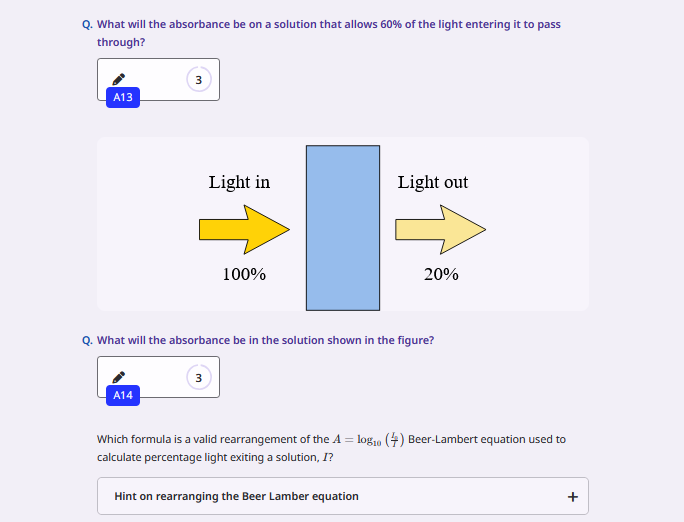
Making pre-lab completion part of overall lab engagement raised students' perception of its importance. Smart Worksheets provided clear, well-structured exercises that offered students immediate feedback and support to improve. Crucially, since The Smart Worksheet Library could be mapped to existing lab sessions, and as the Smart Worksheets were self-marking, they didn't increase academic workloads.
The Results:
Over 80%
typical completion rates for Smart Worksheets:
Following the introduction of Smart Worksheets, student engagement with pre-lab activities increased substantially. Dr Schwartz-Narbonne reported that typical completion rates of Smart Worksheets were over 80%, a marked improvement on previous cohorts where pre-lab engagement was minimal.
70%
The critical attendance threshold
Concerns that students might prioritise pre-labs at the expense of attending laboratory sessions were not borne out. No student passed the module with less than 70% physical lab attendance, indicating that the engagement model supported, rather than undermined, participation in practical teaching.
Educators reported a noticeable shift in how lab time was used. With fewer students struggling through basic calculations at the start of sessions, demonstrators were able to focus on experimental techniques, discussion, and deeper learning. In some cases, lab schedules had to be adjusted because students completed preparatory activities far more quickly than expected.
These changes were reflected in assessment outcomes. Performance in the summative lab test, which accounted for 10% of the final grade, showed a statistically significant improvement. Fewer students failed, and overall cohort performance shifted upward.
Importantly, these gains were achieved without an increase in student complaints about workload. Despite introducing more structured pre-lab preparation than in previous years, module evaluations contained no negative feedback about the pre-labs being too demanding. As the Smart Worksheets were self-marking, there was also no increase in academics' marking burden.
The success of this work reflects a collaborative effort across teaching staff, students, and partners. Building on Dr Schwartz-Narbonne’s leadership of the intervention, the project was supported by colleagues across Sheffield Hallam University, including Miss Imaan Huseeb — who played a particularly important role in analysing the data as part of her Level 6 capstone project, contributing directly to the evidence base demonstrating the impact of Smart Worksheets on student engagement and outcomes — Dr Ines Ramos-Harrison, Mr Andrew Kenny, Dr Tanya Klymenko (now at the School of Biological and Behavioural Sciences, Queen Mary University of London), Ms Franziska Ludwig, and Dr Jef Clark.
The project was also supported by Ms Emily Coyte and Prof Leanne Williams at LearnSci, whose input helped ensure that the Smart Worksheets were effectively aligned to the curriculum and integrated in a way that supported both students and staff.
Together, this cross-institutional collaboration demonstrated how thoughtful curriculum design supported by structured digital resources can strengthen student confidence, improve laboratory efficiency, and deliver measurable improvements in learning outcomes. For departments seeking to support large and diverse cohorts while managing workload and resource pressures, the work at Sheffield Hallam offers a practical, evidence-informed model for enhancing first-year laboratory teaching.
The findings from Sheffield Hallam’s Smart Worksheets intervention have now been published in Emerging Topics in Life Sciences in the article “Integrating Smart Worksheets into mandatory pre-laboratory exercises increased exercise completion rates and laboratory test grades”.